


Opt-in Class B to fulfill zakat easily
Starting 25 May 2026, fixed price funds are now categorized into two classes

All existing fixed price fund unitholders have been automatically placed in Class A. There are no changes to your investment or how you receive your income distribution. You will continue to receive it in full, without any zakat deduction.

For Muslim unitholders who would like their zakat managed seamlessly on their behalf, you may opt in to Class B. Once opted in, you will receive your income distribution net of zakat.
Example of Net Dividend Rate Calculation:
5.75* - (2.57% x 5.75%) = 5.60%
*ASB 2025 income distribution & bonus rate.
- Calculation based on the al-Mustaghallat method, with a rate of 2.57%

Zakat assessment for ASNB fixed price funds has received pandangan hukum from Majlis Kebangsaan Bagi Hal Ehwal Agama Islam Malaysia (MKI) Muzakarah Committees as well as approval from State Fatwa Committees.

- Jawatankuasa Muzakarah Majlis Kebangsaan Bagi Hal Ehwal Agama Islam Malaysia (MKI)
- Jawatankuasa Perundingan Hukum Syarak Wilayah Persekutuan
- Jawatankuasa Perundingan Hukum Syarak Negeri Pahang
- Jawatankuasa Fatwa Negeri Pulau Pinang
- Mesyuarat Jemaah Ulama Majlis Agama Islam dan Adat Istiadat Melayu Kelantan
- Jawatankuasa Fatwa Negeri Kedah
- Jawatankuasa Fatwa Negeri Melaka
- Jawatankuasa Fatwa Negeri Perak
- Jawatankuasa Fatwa Negeri Sabah
- Jawatankuasa Fatwa Negeri Terengganu
- Jawatankuasa Fatwa Negeri Selangor
Advantages of choosing zakat khultah
Zakat calculation is done Automatically, without manual calculation

Zakat payment is managed by ASNB

Ensures zakat does not reduce the investment capital value

How to join Class B?
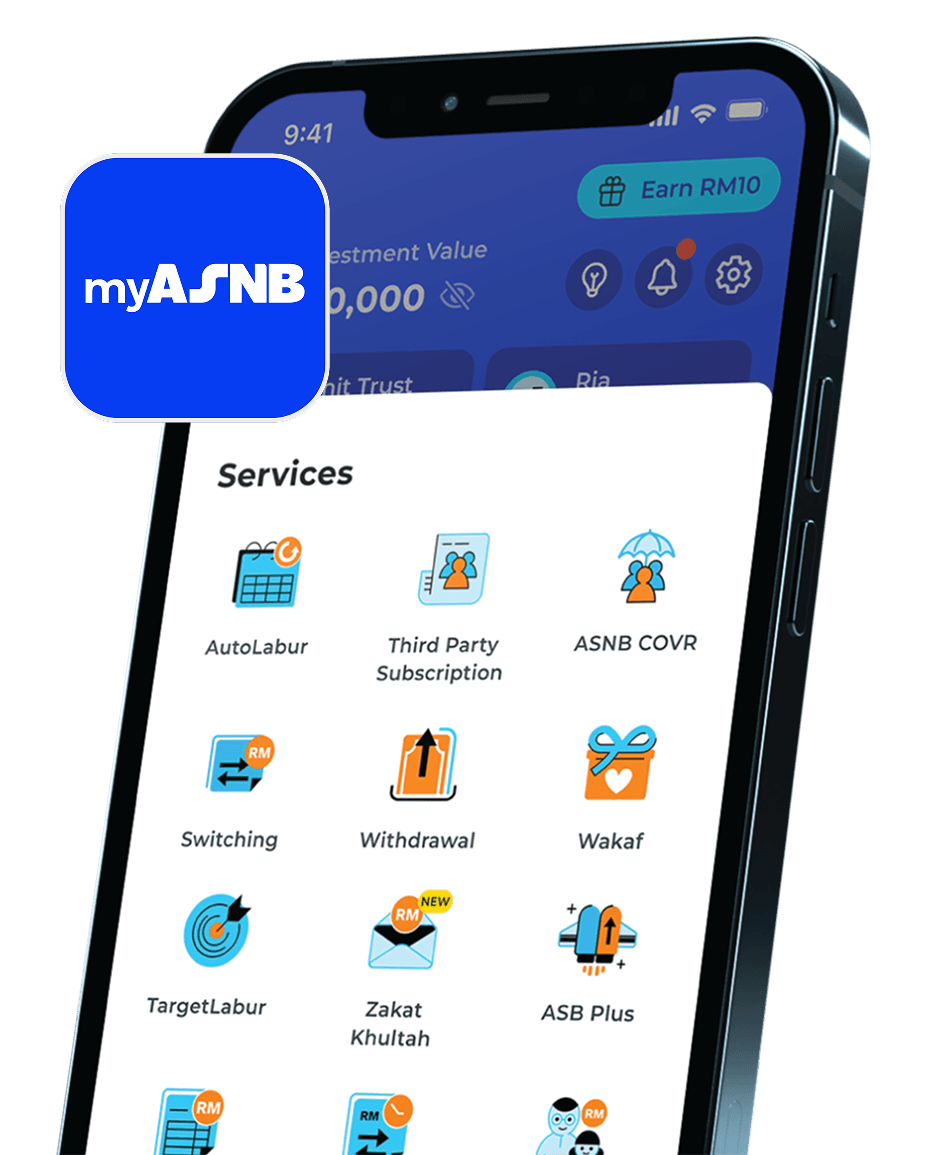
Online via myASNB portal & application
- Log in to myASNB and select zakat khultah
- Select the fund you wish to opt-in for Class B
- Review and approve the selected fund
Over the counter & kiosk
Visit an ASNB branch or agent

Watch the video tutorial to opt-in Class B via myASNB
FAQ
- What is al-Mustaghallat and khultah method?
Al-Mustaghallat
Al-Mustaghallat refers to income derived from the leasing or use of an original asset that is not subject to zakat. For example, buildings and vehicles are basically exempt from zakat. However, if they are no longer basic necessities and are used to generate income through rentals or other means, that income becomes al-Mustaghallat property, and zakat is imposed on the generated revenue.
In the context of ASB, the al-Mustaghallat zakat calculation is applied only to the income distribution (dividends) and does not include the principal or investment capital.
Imam Syafi’i, in his book al-‘Umm, states: "Assets that are not purchased for trade are not subject to zakat. Therefore, whoever owns a house or a bathhouse to generate income (ghallah) or otherwise, or clothing (whether much or little), or slaves (whether many or little), no zakat is imposed on the assets themselves. Likewise, zakat is not imposed on that income until a full year (haul) has passed in the owner's hands. Similarly, for office rentals, zakat is not due before reaching the haul.”
Khultah
Khultah refers to the pooling of assets owned by two or more individuals such that they can no longer be distinguished. This leads to a collective zakat calculation as if the assets belonged to a single individual. For instance, Al-Shirazi in the book Al-Muhazzab fi fiqh al-Shafi’i explains that khultah occurs when livestock owned by two or more people are mixed and treated as if they are owned by one person.
In the context of ASB, zakat khultah means the zakat is calculated from the ASB fund as a single entity, regardless of the number of investors or the individual nisab (minimum threshold) and haul (holding period) of each investor.
The ruling on zakat khultah is derived from a hadith narrated by Anas bin Malik from Abu Bakar RA, where the Prophet SAW said:
"Do not combine what is separate, and do not separate what is combined (of zakat assets) to avoid paying zakat. And for two people whose assets are mixed, zakat must be issued from both of them proportionately (pro-rata)."(Narrated by Bukhari).
- Which ASNB funds apply the al-Mustaghallat zakat calculation on a collective (khultah) basis, and why is it suitable?
The al-Mustaghallat zakat calculation on a khultah basis is applied to all ASNB fixed price funds, namely ASB, ASB 2, ASB 3 Didik, ASM, ASM 2 Wawasan, and ASM 3. This method is considered more suitable for ASNB fixed price funds because the price per unit is fixed at RM1.00. Therefore, no capital gain is generated if the units are traded.
- How is the al-Mustaghallat zakat calculated?
The calculation is based on the income distribution and bonuses (if any) received from the investment, at a rate of 2.57%. For example, if a unit holder receives a total income distribution and bonus of RM50,000, hence the zakat due is 2.57% of RM50,000 which equals to RM1,285.
- Why is the zakat rate applied 2.57% instead of the usual 2.5%?
The basis for determining haul for zakat is based on the Hijri (Islamic) calendar. However, the current calendar used globally, including by Muslims, is the Gregorian calendar. Since ASNB funds’ zakat is calculated according to the Gregorian calendar, the zakat rate is adjusted to 2.57%, taking into account the 10 to 11-day difference between the Gregorian calendar (365 days) and the Hijri calendar (354 days).
This approach is in line with the recommendation of the PNB Shariah Advisory Panel. The 2.57% zakat rate is also adopted by the Accounting and Auditing Organization for Islamic Financial Institutions (AAOIFI) in their Financial Accounting Standards for zakat (FAS 9).
- Has this zakat al-Mustaghallat calculation on a collective (khultah) basis been approved by any of the state fatwa committees?
Yes. This method has obtained approval from the Majlis Raja-Raja and Jawatankuasa Muzakarah Majlis Kebangsaan Bagi Hal Ehwal Agama Islam Malaysia (MKI), as well as from 10 state fatwa committees - Wilayah Persekutuan, Pulau Pinang, Pahang, Kelantan, Kedah, Melaka, Perak, Sabah, Terengganu, and Selangor. Discussions are ongoing for approval in the remaining states.
(Official Fatwa Reference from Jawatankuasa Muzakarah Majlis Kebangsaan Bagi Hal Ehwal Agama Islam Malaysia (MKI): Click here)
- What are the advantages of this zakat al-Mustaghallat calculation on a collective (khultah) basis?
This method ensures that zakat does not reduce the principal investment value, which aligns with the investment objective of generating income from invested funds. Unit holders also do not need to calculate or pay zakat individually, as they will receive their net income distribution after zakat deduction.
- Is the zakat calculation categorized as zakat perniagaan or zakat pelaburan?
Zakat for ASNB fixed price funds is categorized as zakat pelaburan. While the zakat categorization may differ across states, it does not fall under zakat perniagaan.
- How are the nisab and haul determined for unit holders that opt-in for this zakat al-Mustaghallat payment on a collective (khultah) basis?
Nisab is assessed collectively based on the total dividends of the group of unit holders who choose to receive their income distribution net of zakat.
As for the haul, zakat al-Mustaghallat on a khultah basis does not require waiting for a full year (haul) to pass. Zakat may be paid immediately as the income is received, consistent with views of several fuqaha that zakat on the newly acquired income can be paid immediately upon receiving it.
What is Class A and Class B for fixed price funds?
Effective 25 May 2026, ASNB fixed price funds are categorized into a ‘multi-class’ structure and all existing fixed price fund unit holders are automatically placed in Class A.
Through this ‘multi-class structure’, Class A unit holders will receive their income distribution without zakat deduction, which is similar to the income distribution treatment prior to the introduction of ‘multi-class’. Meanwhile, Class B unit holders will receive their income distribution after zakat deduction, which is calculated using the al-Mustaghallat method.Who is eligible to opt-in to Class B and where can I opt-in?
Only Muslim unit holders (adult or Remaja/Bijak accounts) are eligible to opt-in to Class B for ASNB fixed price funds. For Remaja/Bijak accounts, the guardian may opt-in to Class B on their behalf.
Opt-in to Class B can be made through the following platforms:
• ASNB branches
• Agent branches
• myASNB app and portal
• ASNB kioskIf I have opted-in to Class B, can I switch back to Class A?
No. Once a unit holder has opted-in to Class B for a fixed price fund, that fund will remain in Class B and reversal to Class A is not allowed.Can unit holders have both classes for the same fixed price fund (e.g., ASB Class A and ASB Class B)?
No. Unit holders are not allowed to have both classes for the same fixed price fund. Each fund can only be in one class.If I opted-in to Class B for ASB, will my other fixed price funds be automatically opted-in to Class B as well?
No. The opt-in is fund-specific. Unit holders must manually choose to opt-in to Class B for each fund they own.Will my opting-in to Class B made at ASNB or Agent counters be instantly updated across all platforms, such as myASNB or agent’s digital platform?
Yes, it will be updated in real-time across all official ASNB platforms. However, the fund class display on agent’s digital platform may experience a temporary delay due to ongoing system enhancements.If I open a new fixed price fund account, can I opt-in to Class B immediately?
Yes, if the account is opened at an ASNB branch or agent branch. For accounts opened via ASNB or agent digital platforms, the unit holder will be automatically categorized in Class A. Opt-in to Class B can then be done immediately via the myASNB app and portal, ASNB Kiosk, ASNB branches or agent branches.- When is the deadline to opt-in Class B to ensure zakat is deducted for the current financial year?
Unit holders are recommended to opt-in Class B before the suspension period of the fund, to allow zakat deduction for that financial year. If unit holders opted-in to Class B during the suspension period, the zakat deduction will only take effect in the following financial year.
Will zakat be applied to the entire income distribution?
Zakat will only be applied to the income distribution that is redeemable by unit holders. If unit holders cannot redeem a portion of their income distribution, zakat will not be calculated on that portion.
For instance, zakat is not applied on income distributions earned through the EPF Members Investment Scheme (EPF-MIS) as that income distribution portion cannot be redeemed.If I have both cash investment and ASB Financing (ASBF) in ASB, will the zakat be calculated on the total income distribution received, or on the income distribution received from the cash investment portion only?
Zakat will be calculated on the total income distribution received from both types of investments (cash and ASBF), as the income distribution received from both investments are redeemable.Where will the zakat for Class B unit holders be paid, and can unit holders choose a specific Pusat Zakat Negeri (PZN) for the zakat payment?
Zakat will be paid to PZN throughout Malaysia based on the unit holder's mailing address registered in the ASNB system.
Therefore, unit holders are advised to ensure their mailing address are always up to date so that zakat can be paid to the respective PZNs.
However, these payments are subject to the PZNs having met the specific technical and system requirements. If the respective PZNs have not yet met these requirements, the zakat payment will be automatically paid to PZN Wilayah Persekutuan (PPZ-MAIWP).Which Pusat Zakat Negeri (PZN) have currently met the technical and system readiness requirements to receive zakat payments?
As of 29 September 2026, there are 8 PZNs, namely PZN Wilayah Persekutuan (PPZ-MAIWP), PZN Terengganu (MAIDAM) and PZN Pahang (PKZ Pahang), PZN Kedah (LZNK), PZN Perak (ZAPAR), PZN Selangor (LZS), PZN Kelantan (MAIK) and PZN Pulau Pinang (ZAKAT MAINPP). For other relevant PZNs, system enhancements are currently ongoing and ASNB will provide updates from time to time.When will ASNB make the zakat payments on behalf of Class B unit holders?
Zakat payments will be paid to each respective Pusat Zakat Negeri (PZN) within five (5) working days after the fund's financial year ends.How can I check the amount of zakat deducted for my Class B holdings?
Unit holders can check the total zakat deduction through the following platforms:
• ASNB branches & Agent branches
• myASNB app & portal
• ASNB kiosk
• Agents' digital channels
Unit holders may also check the total zakat deduction through the income distribution statement, which will be provided to unit holders after the fund's financial year ends.- How can I check records of past zakat payments made by ASNB for all my Class B funds?
You can check your zakat payment records for a period of up to 7 years via the zakat khultah function on the myASNB platform, starting from the year you opted-in to Class B.
- Can Class B unit holders claim a tax rebate for the zakat deducted?
Yes. Class B unit holders can claim a tax rebate using the official receipt issued by the relevant Pusat Zakat Negeri (PZN).
How will the zakat payment receipt be distributed to unit holders?
Zakat payment receipt will be sent by the relevant Pusat Zakat Negeri (PZN) to unit holders’ email address registered in the ASNB system. or unit holders may check the receipt through the relevant PZN portal within thirty (30) business day after the fund's financial year end.Therefore, unit holders are advised to ensure their email address is updated so that the receipt will be delivered successfully.
How can unit holders obtain the zakat payment receipt if they do not have a registered email address in the ASNB system?
Unit holders who do not have an email registered in the ASNB system can obtain the zakat payment receipt through the official portal of the relevant Pusat Zakat Negeri (PZN) or by contacting the respective PZN.
To access the official PZN portal, unit holders must first register an account if they do not have one. The receipt can then be accessed after logging into the portal.- How can unit holders know which Pusat Zakat Negeri (PZN) they should contact to get more information on the zakat payment?
Unit holders can check the PZN entity that received the zakat payment through the Zakat Khultah Dashboard in myASNB app or portal, which will be available ten (10) working days after the fund’s financial year end.
Unit holders may also visit ASNB branches or contact ASNB customer service at 03- 77308899 or email asnbcare@asnb.com.my to find out the relevant PZN entity.
- Are zakat payment receipts issued in the name of the Bijak/Remaja account holder or the registered guardian?
Zakat payment receipts for Bijak/Remaja account holders are issued in the names of their registered guardians, except for the ASB 3 Didik fund in 2026.
- If I opt-in to Class B for ASB in June 2026 and zakat is deducted for the fund’s financial year ending 31 December 2026, can I claim a tax rebate for Year of Assessment 2026 during e-Filing submission in March 2027?
No, because the ASB zakat payment for the financial year ending 2026 will be recorded in January 2027. For your information, ASB zakat deductions are processed automatically on the same day that income distribution is credited to the account, which is on 1 January of each year. The zakat deducted on 1 January 2027 will be transferred to the Pusat Zakat Negeri (PZN) within five (5) working days.
Since the zakat payment transaction is completed within the 2027 calendar year, it is considered a zakat payment for the Year of Assessment 2027. Therefore, the tax rebate for this transaction can only be claimed during the e-Filing for Year of Assessment 2027, which takes place in 2028.
Can I use the al-Mustaghallat method for zakat payment of my fixed price fund zakat if I do not opt-in to Class B?
No. The approval from the fatwa institutions is specific for the implementation of the al-Mustaghallat via khultah basis, which is a zakat calculation and payment facility available exclusively through Class B opt-in.Can I opt-in to Class B if I live abroad, and where will my zakat payment be channeled?
Yes, you can opt-in to Class B via the myASNB app or portal. If both your mailing and residential addresses are overseas, your zakat payment will be automatically channeled to Pusat Zakat Negeri Wilayah Persekutuan (PPZ-MAIWP).Is the gross income distribution rate the same for Class A and Class B?
Yes. Only the net income distribution rate will differ for Class B after zakat is deducted on the applicable income distribution.How can I know the net income distribution rate for Class B of a fixed price fund?
The net income distribution rate for Class B can be found in the fund’s Annual Report for the respective fixed price fund.Will ASNB provide a zakat calculator to help Class A unit holders calculate their zakat?
ASNB does not provide a zakat calculator. Unit holders are encouraged to opt-in to Class B for automatic and seamless zakat deductions.- Would zakat payments made via zakat khultah be considered for unit holders’ wakalah eligibility?
Yes, subject to the wakalah eligibility rate and the guidelines set by each respective Pusat Zakat Negeri (PZN).